Project
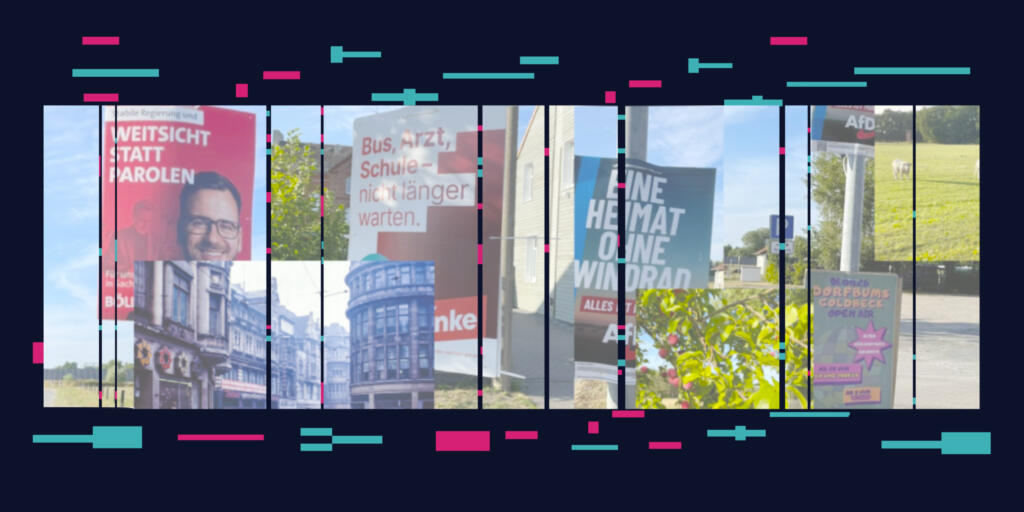
In early September, Germany’s far-right Alternative für Deutschland (AfD) party is projected to score unprecedented wins in elections in Saxony-Anhalt. As populist right parties continue to rise in Germany and across Europe, journalists are confronted with questions about how to report on them while grappling with political polarization, audience fragmentation, platform algorithms, and disinformation.
In the wake of the Saxony-Anhalt election, eight selected journalists will visit three cities in the region:
Magdeburg, where coalition negotiations are underway three weeks after the election
Bitterfeld-Wolfen, a town whose post-reunification trajectory from industrial collapse to economic recovery tells a more complicated story than it might seem
Halle, where civil society groups are responding to the election result in different ways
Taking place one week after state elections in Mecklenburg-Vorpommern, the trip invites journalists to look beyond coalition arithmetic and explore the sociopolitical context of Eastern Germany; the factors leading to unprecedented AfD support in the region; and what this means for the rest of the country and Europe.
Reporting independently for their home outlets, journalists will meet with local politicians, journalists, and civil society actors involved in the election. They will also have the opportunity to connect with fellow reporters from across Germany, Central and Eastern Europe, and the Caucasus. All travel and accommodation expenses in both Saxony-Anhalt and Berlin are fully covered.

This research trip is an integral part of the main n-counter conference taking place in Berlin on 2-3 October 2026.
We are looking for journalists who see connections between what is happening in Saxony-Anhalt and their own countries, whether that is the rise of the far right, post-communist transformation, or the difficulty of reporting on a place that is harder to understand from the outside than it looks.
We invite editors, journalists, and correspondents from Central/Eastern Europe (including Germany) to apply if they:
Please note: the Research Trip is an integral part of the n-counter conference in Berlin, and participants will present some of their findings there.
Dates: Wednesday, 30 September – Sunday, 04 October 2026
Application deadline: 16 August 2026 (23:59 CET).
Should you have any questions, feel free to reach out: community@n-ost.org.
The Research Trip to Saxony-Anhalt is supported by the Friedrich Naumann Foundation.
Please note: Applications for the research trip are now closed.
10:12 dep. Berlin-Charlottenburg → 11:50 arr. Magdeburg
How are democratic parties responding to the election results? What do coalition negotiations reveal about the state of democracy in Saxony-Anhalt?
Overnight Stay: Magdeburg
10:06 dep. Magdeburg → 11:16 arr. Bitterfeld-Wolfen
What has changed in Bitterfeld-Wolfen since reunification, what hasn't, and how does the local press cover both?
Overnight Stay: Halle
What is working in the response to the far right, and what can be taken back to similar debates in Central and Eastern Europe?
Return to Berlin around 13:00
Cross-border and multiperspective reporting in your inbox
A monthly overview of project news, selected queer stories and job opportunities. At the moment focused on History Unit, a project about the persecution of queer people under National Socialism and today.

A daily roundup of European media debates, available in English, German, French, Russian, and Turkish.

The Eurasian Climate Brief is a podcast focusing on climate news in the region stretching from Eastern Europe, Russia down to the Caucasus and Central Asia.

Weekly insights on the war against Ukraine discussed in European media, debunking disinformation, and spotlighting key narratives and voices from Ukraine.

Communicating Climate in Central Asia curated this newsletter. A monthly newsletter dedicated to strengthening climate journalism and communication across EECCA region.