Featured Article
“The majority doesn’t want elections during the war, but time isn’t on the authorities’ side”
Published on Jan 16, 2025
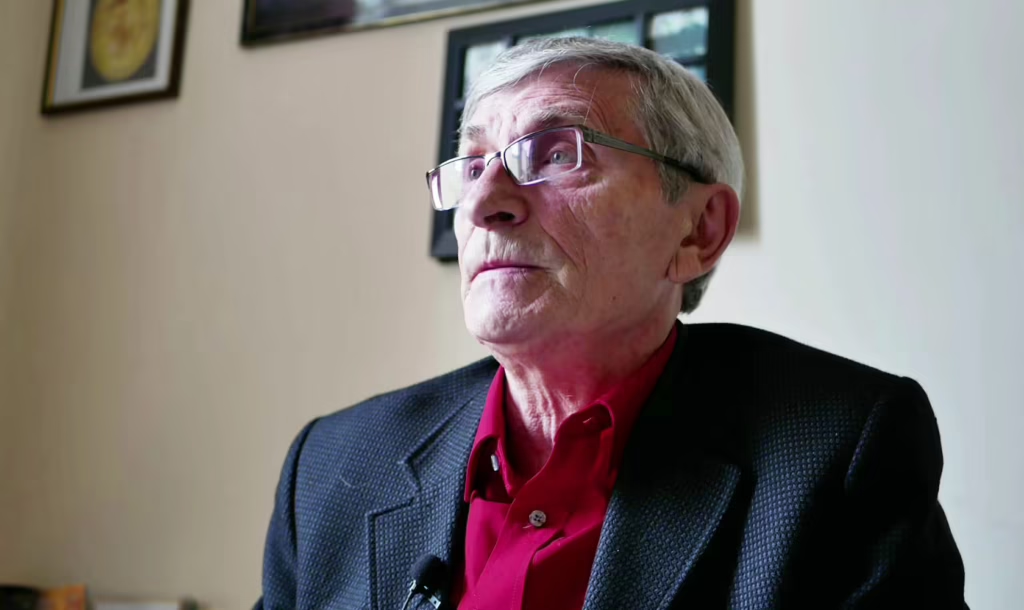
How is the public sentiment of Ukrainians changing during wartime? Yevhen Holovakha, head of the Institute of Sociology of the Academy of Sciences of Ukraine, breaks down the data.
Ukrainian article of the week published in the 61st edition of the "What about Ukraine" newsletter on January 16th, 2025. The article was written by Rustem Khalilov and Mykhailo Kryhel for Pravda and was translated for n-ost by Olesia Storozhuk. Find the original article in Ukrainian here.
Ukrainian society that can help the country see itself as it is, undistorted by the social media bubble?
Sociology can offer such a reflection — even though the image does not give a complete picture. Surveys can gauge the public sentiment, though they fail to capture three large groups: the military, residents of temporary occupied territories, and displaced people living abroad.
Such surveys can be shocking. An opinion poll conducted in July 2024 revealed that 46 per cent of Ukrainians living away from the frontline believe there is no shame in being a draft dodger.
Other polls “sober up” the people to the current situation. Most respondents consider that elections are irrelevant now. The war has papered over the cracks in the political class with a show of professed national unity.
Sociology reveals how the war has changed Ukrainians, their attitude to negotiations with Russia, migratory sentiments, the psychological condition of those who stayed in the country, and trust in the authorities, its institutions, and politicians.
And it is Yevhen Holovakha, head of the Institute of Sociology of the Academy of Sciences of Ukraine, who knows everything about sociology.
We interviewed Holovakha on New Year’s Eve, showing him as a comic book hero forecasting 2025. Unfortunately, the graphic novel format leaves no space for remarks longer than a few words. Since the conversation was in-depth and relevant, we have presented its main points here.
Below we publish Yevhen Holovakha’s direct speech.
Hesitations over victory
How confident are you in Ukraine’s victory over Russia? We asked this question in our survey. In December 2022, three-quarters of the respondents were absolutely confident in the victory. Together with those who were rather confident, they constituted 96 per cent, while only one per cent was absolutely unconfident.
In November 2024, only 39 per cent were absolutely confident and 28 per cent were rather confident. This does not mean most people do not believe in victory, but they have some doubts and hesitations.
I see nothing dramatic about this. These data clearly correlate with people’s mindsets and their assumptions about the future.
Now let’s view the Autumn 2024 data conducted by researchers at the sociological group Rating. They asked their respondents: ‘How do you see Ukraine’s future — as rather promising or rather unpromising?’ Currently, over three-quarters see the situation as promising for Ukraine.
Back in 2022, nearly no one saw the future as unpromising, while this has increased to ten per cent, which means some people feel disappointed.

Observing this almost three-year trend, I wouldn’t forecast dramatic despair in 2025 — unless the new [Trump] administration will say: agree with Putin’s conditions or [we cut the] oxygen.
Such a scenario may significantly affect people’s moods.
Mobilisation: a slight change in views
If the West provides us with sufficient [military] assistance, our army’s prestige will grow. Otherwise, people won’t be willing to join the military, as they will have nothing to fight with. However, the problem of mobilisation runs deep.
Rating’s research asked Ukrainians: do you have acquaintances who left their jobs due to mobilisation and now work illegally? Thirty per cent said “yes” — a very high percentage.

To arouse public consciousness, a shocking situation is needed, like the beginning of the full-scale invasion. Now, unfortunately, the war has become routine in people’s minds. Many think that the war happens by itself.
For the majority of people to realise that nothing happens without effort, we need to find ways to influence the awareness of ordinary people. We must explain that Ukraine faces existential threats. If we don’t defend the country, it will disappear, and Russia will only allow people to exist if they renounce their identity.
Now, 80 percent of Ukraine’s residents identify themselves primarily as citizens of their state. Without Ukraine, with which nation will they identify themselves
Conditions for negotiations: NATO security guarantees desired
The Kyiv International Institute of Sociology has undertaken extensive research on Ukrainians’ attitude to negotiations with Russia.
A growing number of people would agree to freeze the borders of today’s frontline and start negotiations.
If the trends of the last two years continue, by 2025, we will see more people who will agree to ceasing [warfare]. However, they will not constitute the majority.
Territories for peace: options on table
In December 2024, the Kyiv International Institute of Sociology (KIIS) conducted a nationwide survey, ‘Omnibus’, including a question about territorial concessions.
In May 2022, the share of those ready to give up some Ukrainian territories was ten per cent compared to 82 per cent of those who wouldn’t agree under any conditions. In December 2023, the first group grew to 19 per cent, while the second decreased to 74 per cent. In December 2024, almost 38 percent of the respondents were ready to exchange territories for peace, while 51 percent disagreed with this compromise.
KIIS also studied Ukrainians’ attitude to possible types of peace agreements. Here are the views on three potential package deals:
Package No. 1
Russia maintains control over all currently occupied territories;
Ukraine refuses to join NATO;
Ukraine becomes a member of the European Union and receives the recovery funding needed [from the west].
Package No. 2
Russia maintains “de facto” control over the occupied territories in the Zaporizhzhia, Donetsk, Kherson and Luhansk regions and in Crimea, which Ukraine does not officially recognise;
Ukraine joins NATO and has real security guarantees;
Ukraine becomes a member of the European Union and receives the recovery funding needed [from the west].
Package No. 3
This differs from the Package No. 2 in that Ukraine regains complete control over the Zaporizhzhia and Kherson regions, but ceases fighting for territories in Donetsk, Luhansk and Crimea.
The diagram below shows the June and December 2024 views on each package. These show a majority combination of an “agreement” and “hard, but acceptable” option only for Package 2 in December 2024, and Package 3 in June and December 2024.

“Although Ukrainians remain flexible and open to discussions regarding the terms of peace agreements, they definitely do not agree with ‘peace at any cost,’” the sociologists assess from this data.
Elections: majority against during wartime
2025 will undoubtedly strengthen the request by some elites to revive political life and hold future elections.
Why now? Politicians are nourished by the awakening of a mass consciousness. Recently, they have sensed some shifts in the civic mood. At the outbreak of the full-scale invasion, Ukrainian society was consolidated. Over time, the criticism towards authorities began to increase, along with the number of people unhappy with their leaders’ decisions. Politicians have sensed a change in the public mood, and have started actively preparing for elections.
Time is not on the side of the current political leadership. It would be on their side if we saw victory after victory [on the battlefield]. In the context of a further conservative war scenario and gradual territorial losses, the authorities will further lose popularity.
However, the latest sociological surveys from autumn 2024 demonstrate that the majority are against elections during wartime. Firstly, there is no public demand. Secondly, elections during wartime are against the law. Thirdly, they would be hard to organise. We are also not even taking into account their cost, when people lack money for more vital things.

Obviously, after martial law is lifted, voters will primarily pay attention to the position of military representatives and volunteers, who are the two institutions that enjoy the greatest support in society.
The army has already nominated its candidate. The latest poll has shown a very high trust score for Valerii Zaluzhnyi, former commander-in-chief of the Ukrainian Armed Forces and current Ukrainian Ambassador to the UK.
I don’t yet see such a strong personality coming from the volunteers.

But this is only about the future. Today, no platforms exist for “new faces” in politics to significantly impress the people, mainly because there is no political theatre, only the theatre of war. The country lacks a normal political life. It is thus pointless to discuss elections. Once martial law is lifted, the time will come for electoral sociology.
Populism: Ukraine was ahead of the trend
The last few years have brought the understanding that we are citizens of one country, that there are many more issues that unite us than divide us, and substantial changes to Ukrainian identity and the geopolitical focus of the country. At the same time, I don’t think there have been significant shifts in political life.
Nowadays, populism as a political trend is widely discussed, particularly in American politics. However, Ukrainian politicians were far ahead of this trend, even before it spread worldwide.
We long for quick victories and miracles — and always get disappointed if they don’t happen.
At the upcoming elections, whenever they take place, we will again expect miracles. We will support those who promise us quick victories and recovery.
To overcome populism in politics, society must go through a school of democracy. War isn’t the best such school, but the worst.
Psychological condition of Ukrainians: higher distress
Our institute studies war-induced stress. In late 2022, only 12 per cent of Ukrainians residing on the Ukraine-controlled territories experienced high levels of distress. Distress is a state of prolonged stress that affects people's mental and physical health and can have a long-term impact.
The October 2024 survey showed that 27.1 percent of Ukrainians have a high level of distress. In 2025, this percentage was even higher.

In a potential future scenario of heavy fighting and the loss of part of the southern and eastern territories of Ukraine, people’s mental health indicators would likely worsen, leading to a lower ability to cope with distress.
However, I believe that the country’s vitality will withstand 2025. I think this will also be the case in 2026, the year when Russia will start crumbling, as it will be unable to have enough weapons and military personnel. This is my forecast, backed by the opinions of numerous experts in economics. Sometime in 2026, Russia will be looking for ways to stop the war.
By the way, guess what was the major stress-inducing factor for the Ukrainian people according to our research? Worrying about what they have seen in the media. But this factor has always come first.

Ukrainians: patriotic, but fatalistic
The majority of Ukrainians believe in fate.
There is a psychological term called ‘externality’, which Ukrainians are prone to. This implies that a person believes everything in their life is determined by external events, rather than by themselves. ‘Internality’, in turn, is when you admit the influence of external factors on your life, while taking responsibility for your life events. In Ukraine, there are more externals than internals.
When asked about patriotism, most people express themselves as patriots. Still, many people believe everything will work out by itself. They are more ready to wait for [victory] to happen, than risk their lives to secure it. Maybe that is why Ukrainians can’t succeed in many aspects of state-building.

Return of the displaced: harder with each new year of war
In November, our institute surveyed the Ukraine-controlled area, asking: “Do you consider moving from your place of residence in search of a better life?” 52.3 percent of respondents admitted they were not interested in moving anywhere, not even within the country.
It is difficult to predict how many of those millions of people who have moved abroad since February 2022 will return to Ukraine. Even if they express such intentions today, this doesn’t mean they will actually come back.
With each new year of the war, we lose the potential [of people to return], as more and more displaced people adapt to life abroad. Those who find jobs and whose children will be integrated aren’t likely to return.
I always refer to the example of the Balkan wars in the 1990s. Back then, many people also fled from war. Eventually, only 30 per cent returned.
Hence, if the hot phase of the war lasts up to five years, we can expect 30–50 per cent of those who left the country in 2022 to return. The exact number will depend on the kind of programme we develop to bring people back, and the attitude in Ukraine towards these people. In 2023, we conducted a survey: 80 percent of the respondents on the territory of Ukraine had no complaints about people who fled. But this trend will change, and not for the better, I believe.
I spoke at one forum and said we need a comprehensive state programme to bring people back. And someone made the comment: “Why should we treat them positively? We are struggling here, while they are enjoying life there.”
Recently, the Ministry of National Unity has been created. The name is a bit embarrassing for me, as I lived in the Soviet Union, where talks and slogans about unity sounded from every corner, such as “Workers of the world, unite!” or “The party and the people are one.” I think I’m not the only one to remember this, and so this name triggers many people. There are modern terms such as reintegration and migration policy which can better reflect the idea.
Indeed, we need not just formal unity, but meaningful consolidation. Formal unity is possible in totalitarian states, where leaders can give the order to the people to be “one” — and they will. What else should they do? Without ‘unity’, they would face jail.
However, we must look for meaningful ways to bring back those who left in a legal way, and help consolidate our society.
Cross-border and multiperspective reporting in your inbox
A monthly overview of project news, selected queer stories and job opportunities. At the moment focused on History Unit, a project about the persecution of queer people under National Socialism and today.

A daily roundup of European media debates, available in English, German, French, Russian, and Turkish.

The Eurasian Climate Brief is a podcast focusing on climate news in the region stretching from Eastern Europe, Russia down to the Caucasus and Central Asia.

Weekly insights on the war against Ukraine discussed in European media, debunking disinformation, and spotlighting key narratives and voices from Ukraine.
