Featured Article
150,000 Ukrainians have allegedly returned to occupied territories. Is this true?
Published on Dec 4, 2024
Ukrainian article of the week published in the 57th edition of the "What about Ukraine" newsletter on November 28th, 2024. The article was written by Diana Kuryshko for BBC and was translated for n-ost by Olesia Storozhuk. Find the original article in Ukrainian here.
“You’re lying,” was the reaction of Iryna Vereshchuk, deputy head of the Presidential Office, to the words of an MP from the pro-presidential parliamentary faction, who claimed 150,000 people have returned to the occupied territories.
On 24 November, the deputy head of the ‘Sluha Narodu’ parliamentary faction Maksym Tkachenko, said in an interview with the state information agency Ukrinform that 150,000 Ukrainians have returned to the occupied territories because the state is ‘delaying support’ for internally displaced people.
This statement caused intense discussions in the Ukrainian media, and denials from the Presidential Office, expressed emphatically by Iryna Vereshchuk, deputy to the office’s head, Andrii Yermak. Vereshchuk is no stranger to this issue: she used to head the relevant ministry dealing with displacement and return.
The day after his controversial statement, Tkachenko retracted his words, saying they were an “emotional assumption.”
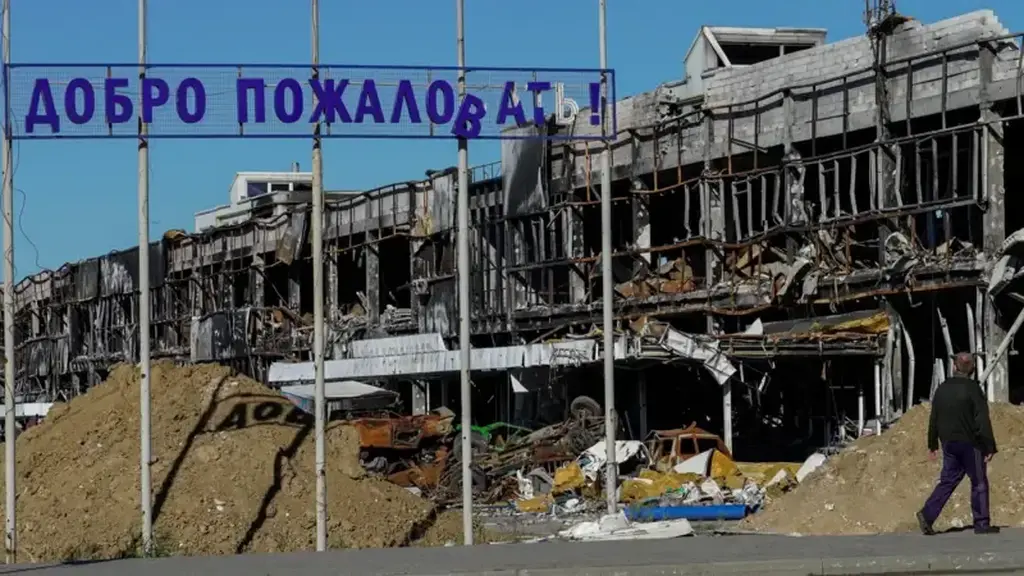
BBC Ukraine studied how many people have returned to the occupied territories, the possible origin of the 150,000 figure, whether it is possible to make such calculations, and why people make the journey back.
Where does the 150,000 number come from?
This is not the first time Tkachenko has voiced high numbers of Ukrainians returning to the occupied territories. However, it is the first time his words have provoked such a reaction. The MP heads the working group of the Temporary Special Commission on Housing for IDPs, and therefore, he often comments on IDPs’ problems to the media.
In summer 2024, he stated that, due to problems with finding housing and jobs, 130,000 IDPs were forced to return to occupied areas or the military action zone.
In November 2024, without citing any sources, he claimed that 150,000 people had already come back to occupied territories.
With a difference of only one day, Petro Andriushchenko, the former advisor to the exiled mayor of Mariupol, voiced similar numbers to Kyiv Post, while also mentioning that such movements, in particular, were caused by the cancellation of monthly welfare payments for IDPs amounting to 2,000 UAH (about 46 euro).
According to Andriushchenko, he and his colleagues gathered their data from the number of Ukrainians arriving in Russia through Moscow’s Sheremetyevo airport in recent years. To travel there, according to the media and Andriushchenko, Ukrainians go to the EU and fly to Moscow.
Interviewees from the Presidential Office told the BBC they spent the whole morning of 25 November figuring out the origin of such claims, but it was impossible to find any accurate statistics on this issue.
The Presidential Office assumed that these numbers most probably arose from Petro Andriushchenko.
Tkachenko claimed in his controversial interview that 150,000 displaced people returned to occupied areas (including 70,000 to Mariupol) because they have not received adequate help from the state — “neither housing nor social support, compensations, jobs”.
After the scandal broke in the media, he changed his tune.
“There is no such data,” he said. “This was my unfounded and emotional assumption.”
Iryna Vereshchuk passionately disagrees with the discussions about thousands of people moving to occupied areas. “I will never believe that thousands of Ukrainians are going to Russian occupied territories due to missing UAH 2,000–3,000 (46-68 euro) in state help,” she said, calling Tkachenko’s words “a lie” and “hype for the sake of hot headlines.”
According to Vereshchuk, the state is fulfilling all its promises to the IDPs, but its resources are insufficient.
How many have returned to the occupied areas?
“There is no open data on the number of people returning,” says Lidia Kuzemska, a sociologist studying forced migration of Ukrainians to Russia. “We can’t trust the numbers published by the local occupational authorities.”
According to Kuzemska, some studies show only trends. For example, based on a poll of Ukrainians conducted by the International Organisation for Migration on the border point in Latvia to Russia in 2023, 49 percent intended to return to Ukraine’s occupied territories, while 29 percent headed to Russia or through Russia to the occupied territories for a short visit, and 20 percent did not know how long they would stay in Russia or the occupied territories.
“We definitely know that people leave the occupied territories, and we also know about a small flow of people going back,” says Kuzemska. “The number of people who temporarily went to the territory of Russia and returned to occupied areas is also unknown.”
According to her, we can assume why the flow might have increased recently. In 2023, Russian president Vladimir Putin signed a decree allowing people without Russian citizenship to reside in the occupied territories with their documents, i.e. Ukrainian passports, only until 31 December 2024. After that date, they must apply for a residence permit — otherwise they could face deportation.
“All housing and car documents must be re-registered on Russian databases,” the researcher says. “If people want to keep their property, we may assume that they can return to the occupied territory to receive a passport, sell their property, and leave. We know that people return to Mariupol, but it is not a mass phenomenon. It is definitely not thousands of people.”
In October 2024, the Russian authorities released a figure stating that about 107,000 Ukrainians had been trying to enter Russia via Sheremetyevo airport, but Moscow allowed entry to only 83,000. However the officials did not identify the period of time that gave rise to these numbers.
Kuzemska says it is possible to take into account the 83,ooo figure, but it’s also impossible to prove, as well as work out how many of these people stayed in Russia or the occupied territories, and how many came back to unoccupied Ukraine.
The sociologist cites data from another poll, conducted by the International Organisation for Migration among Ukrainian IDPs in 2024. According to this survey, 88 percent of displaced people do not plan to move anywhere in the next three months, and 70 percent do not plan to change their current residence after this date.
Reasons for going back: “They failed and returned”
The BBC talked to several people whose friends and acquaintances have returned to the occupied areas.
A Kyivan Olena (name changed) knows retired people who returned to the occupied areas of the Donetsk region. In 2022, they fled, but in 2024, they went back.
“A friend of mine persuaded her parents to leave their home at that time, but couldn’t keep them here [in non-occupied Ukraine],” Olena says. “They are older people who were unable to accept living in a rented apartment [in non-occupied Ukraine] and give up a house they invested in for decades. That was very painful for both my friend and I.
“I know people who did their best to settle here and find a job,” Olena adds. “But they hardly made ends meet. They tried to manage it all. They are not pro-Russian, but they returned.”
Olena admits she does not understand such a choice, but cannot condemn it.
“Some people didn’t want to be a burden on others, or they failed financially,” she says. “There are different stories and varied experiences. You can’t generalise. Indeed, it is often difficult for the IDPs to accommodate themselves to a new place. Sometimes, people return out of despair.”
Svitlana comes from a southern Ukrainian city where many people from Kherson (occupied from March to November 2022), Mariupol, and many other occupied Ukrainian towns and villages moved in 2022 after the beginning of the full-scale invasion. Her family helped many IDPs. She knows a couple with children who seemed to have settled there: they found jobs and their children went to a local school. Recently, they have returned to Mariupol.
“It was a very surprising decision for me,” says Svitlana. “I thought they were doing well here. However, they went back even though their apartment in Mariupol was damaged. They had business there. Their daughter makes pro-Russian posts on social media, blaming Ukraine for their hard life, due to the shellings and black-outs.”
“It is difficult to count the number of Ukrainians who returned to the occupied zones,” says journalist Andrii Dekhtiarenko, head of the Luhansk socio-political weekly journal Realna Hazeta, which covers IDPs’ issues. “But does that mean we must close our eyes to this problem? There is no effective support mechanism for displaced people; benefits were cancelled for many of them, and housing is lacking. This is the reality that IDPs in Ukraine face now.”
Alongside the benefit cancellation, Dekhtiarenko argues that a reason for IDPs’ return are fear of spending winter in rented apartments in Ukrainian cities and risking blackouts and bombardment. Many who have houses in the occupied zones have gone back for the winter.
Sheremetyevo airport: single route back
Halyna (name changed) comes from Severodonetsk, which has been occupied by Russia since June 2022. She knows several people who returned to this damaged city via the Moscow Sheremetyevo Airport. Halyna has shown BBC a Viber chat where people discuss returning routes to the Russia-occupied territories.
This shows that Sheremetyevo airport is currently the only route for Ukrainians willing to enter Russia.
Recently, Russia closed the last ground border crossing to Ukraine, between the Sumy and Kursk regions. Earlier, the entry point through Latvia was shut. Now, Ukrainians travel to Belarus, and then take a plane to Moscow. In Sheremetyevo, all Ukrainian citizens undergo “filtration”, which Russian officials call a “small inspection”.
“We were told that filtration takes place only at this airport, which decides who is allowed to enter Russia and who is not,” Halyna says. “Some people are kept for several days, and others stay for a week. People are asked about their opinion on the ‘special military operation’ (Editor: The way Russian authorities force everyone to speak about the war) and who the occupied territories belong to. They check the phones and luggage. Many people are not allowed into the country and have to go back.”
In this Viber chat, which includes around 10,000 participants, people share recommendations about how to get to Minsk and ways to pass the inspection more easily.
Anzhelina, who returned to the occupied Donetsk to sell her property, told Kyiv Post that she had to spend 27 hours on the floor of a small room in Sheremetyevo.
The state TV channel Russia 1 reported on authorities preventing entry to people with tattoos of Kyrylo Budanov (chief of the Main Directorate of Intelligence of the Ministry of Defence of Ukraine) and those who had donated to the Armed Forces of Ukraine.
Despite attempts by Ukrainians to return to the occupied areas, no one is waiting for them there, says Pavlo Lysianskyi, lawyer and director of the National Institute for Strategic Studies.
He estimates that Russia bans entry to the Federation and occupied territories for 80–90 percent of Ukrainian citizens and is forbidding their entry to the country for at least five years.
“Currently, the occupants massively confiscate the local residents’ property, including thousands of flats, and they plan to confiscate more than 300,000 real estate properties,” the lawyer said.
He also speaks about repressions towards the locals.
“The return of Ukrainian citizens to occupied territories doesn’t fit the occupants’ agenda, as they don’t need people with historical memory,” Lysiansky says. “Now, many Russian citizens of different ethnic groups are relocating to the occupied areas.”
Cross-border and multiperspective reporting in your inbox
A monthly overview of project news, selected queer stories and job opportunities. At the moment focused on History Unit, a project about the persecution of queer people under National Socialism and today.

A daily roundup of European media debates, available in English, German, French, Russian, and Turkish.

The Eurasian Climate Brief is a podcast focusing on climate news in the region stretching from Eastern Europe, Russia down to the Caucasus and Central Asia.

Weekly insights on the war against Ukraine discussed in European media, debunking disinformation, and spotlighting key narratives and voices from Ukraine.
